

In the rapidly evolving landscape of industrial equipment and manufacturing, the concept of modularization has gained substantial traction. Among the various modular and plug-n-produce approaches, the Modular Type Package (MTP) approach has emerged as a game-changer, offering unparalleled flexibility, scalability, and efficiency.
MTP, modularity and plug-n-produce trajectory
The trajectory of MTP points toward its status as the industry standard. With its origins dating back 25 years and bolstered by numerous consortia, this concept has gained solid traction, particularly within process industries. By facilitating continuous processing through reduced changeover times and equipment vendor agnosticism, MTP has garnered substantial interest from end-users.
As biotech, pharma and chemical end-users strive to optimize their operations and adapt swiftly to changing market demands, POL (Process Orchestration Layer) and PEA (Process Equipment Assemblies) vendors find themselves at a critical juncture. As competition intensifies efforts to adopt this framework, its potential as a competitive differentiator becomes increasingly clear.
Ten imperatives
In this article, I delve into the crucial technological imperatives that PEA vendors need to embrace in order to create equipment modules that align seamlessly with the MTP approach. (Read more about the MTP framework here.)
By understanding and implementing these imperatives, PEA vendors can unlock a competitive edge, streamline their production processes, and cater to the ever-growing demand for modular, adaptable, and interoperable industrial solutions. From design principles to integration aspects, this article serves as a comprehensive guide for PEA vendors to navigate the dynamic landscape of modular technology and emerge as leaders in the industry.
You can read more about the drivers and challenges of MTP adoption for module producers here.
MTP structure
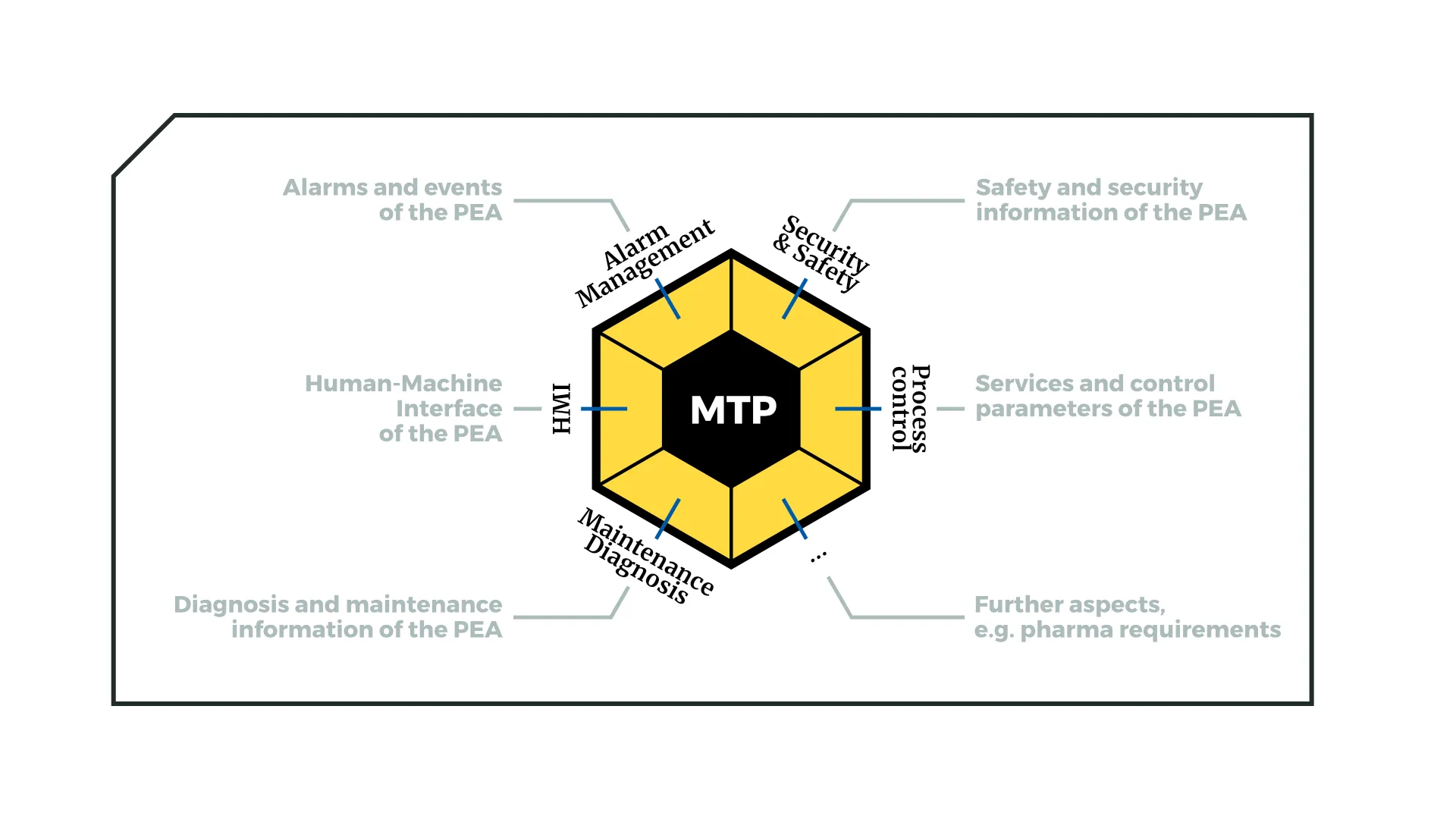
A compliant Process Equipment Assembly exposes six aspects to the orchestration layer. Together they let a module be operated, monitored and maintained as a standardised building block.
Alarm management
Alarms and events raised by the PEA, handled in a unified way.
HMI
The human-machine interface of the PEA for local operation.
Maintenance & diagnosis
Diagnosis and maintenance information exposed by the PEA.
Security & safety
Safety and security functions of the PEA.
Process control
Services and control parameters of the PEA.
Further aspects
Industry-specific needs, e.g. pharma requirements.
Imperatives to create MTP-compliant equipment modules
The ten imperatives below define what a PEA must implement to integrate cleanly with the Process Orchestration Layer (POL).
| # | Imperative | Why it matters |
|---|---|---|
| 1 | PEA should have a modelled interface according to VDI/VDE/NAMUR 2658 | To integrate the process equipment assembly (PEA) into the process orchestration layer (POL). |
| 2 | PEA should be extended with an OPC UA server | For communication between the POL and the PEA. |
| 3 | PEA should implement an extension to execute a state model | To use the state-based interface of the POL for MTP services. |
| 4 | PEA should implement process functionalities as MTP services (with configuration, procedure, process-value and report parameters per VDI/VDE/NAMUR 2658) | Procedural functions should be parameterisable MTP services to allow POL integration — e.g. to use recipes. |
| 5 | PEA should generate alarms and events with specific content (timestamp, source name, description, priority, kind, confirmation) per NAMUR/ZVEI WG 2.9.1, VDI 2658-6 and VDI 2658-7.1 | For proper alarm and event handling in a unified manner in the POL. |
| 6 | PEA should have individual visualization of static and dynamic elements (HMI) | For local operation without the POL, and to generate the system-wide HMI in the POL. |
| 7 | PEA should expose diagnosis and maintenance information on the OPC UA interface | For easy maintenance without access to the entire system or process. |
| 8 | PEA should meet specific industry requirements (e.g. pharma, biotech) | For safety and to meet regulatory needs. |
| 9 | PEA should be ready to connect with different manufacturers’ equipment | For quick integration. |
| 10 | PEA should be ready to work as a standalone device | To operate locally without the POL. |
What’s next?
The MTP concept is now mature enough for PEA implementation by module vendors. Existing POL systems can already process MTP files and manage such PEAs effectively.
Although MTP is not yet widely adopted, it has the potential to become a standard rapidly. Those who are unprepared might fall behind, giving an advantage to early adopters.
At A4BEE, we are well-equipped with the necessary expertise, experience, and skills to guide you through your MTP journey. For more information, refer to our detailed A4BEE MTP offer.